P H R O S : World
Showing posts with label World. Show all posts

Saturday, June 24, 2017

Mexico's Government Replied To A Trump Tweet After He Called It The Second Deadliest Country In The World

11:07 PM 0
Although killings in Mexico have reached a record high, the homicide rate in the country is well below that of other countries across the world.

President Trump on Thursday claimed Mexico is the second deadliest country in the world, behind only war-torn Syria, prompting an official rebuke from Mexico's government asserting Trump's statement was not true.

"Mexico was just ranked the second deadliest country in the world, after only Syria," Trump said in a tweet. "Drug trade is largely the cause. We will BUILD THE WALL!"

Mexico's Secretary of Foreign Affairs Luis Videgaray Caso responded to his tweet, disputing the claim.

"While Mexico does have a significant problem of violence, Mexico is NOT the second most violent nation in the world," a statement from Mexico's Foreign Ministry read. "According to UN figures for 2014 (the most recent international report), Mexico is far from being one of the most violent countries."

Videgaray Caso even tagged Trump in a tweet responding to his claim.

Press Release

The country's response came just hours after Trump fired off his post, blaming the drug trade for the increase in violence south of the US and using the issue to reference his campaign promise to build a border wall.

While data released this week showed the number of homicide investigations in Mexico in the month of May hit a record high of 2,186 investigations, the wording from the president and comparison to Syria appeared similar to a report published in May by the International institute for Strategic Studies, which pointed to the approximately 23,000 killings last year in Mexico.

The report compared those numbers to Syria's ongoing civil war, which claimed about 50,000 lives the same year.

However, blankly comparing bulk crime numbers from one country to another, without taking into consideration the population, does not provide an accurate comparison.

Instead, criminologists look at the crime rate (the number of murders per 100,000 people) to get a clearer picture of violence in a region. As the statement from Mexico notes, this measure shows the country has a murder rate of 16.4 — far from the highest in Latin America, let alone the world.
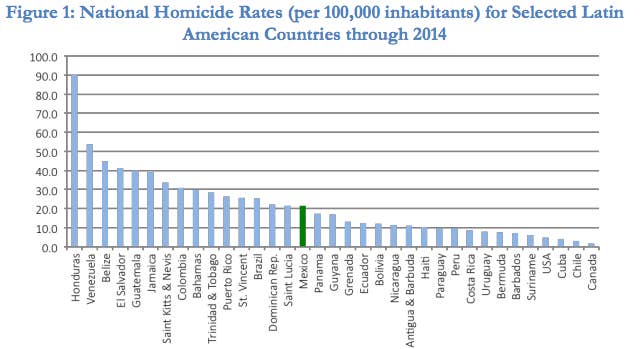
According to the latest data from the United Nations Office on Drugs and Crime, the Dominican Republic, Guatemala, El Salvador, and Colombia have higher homicide rates than Mexico.

Honduras, with a homicide rate around 90 killings per every 100,000 people, tops the list of most dangerous Latin American countries — a point addressed in Mexico's press release, which also stated the US demand for illicit drugs is responsible for the rise of cartel violence inside Mexico.

"Drug trafficking is a shared problem that will end only by addressing its root causes: high demand for drugs in the U.S. and supply from Mexico," the statement read.

For good measure, Mexico's statement was published in both Spanish and English.
Read More

Friday, June 16, 2017

European Governments Are Confused Because US Officials Keep Changing Their Stance On Trade

7:18 AM 0
Representatives have disclosed to BuzzFeed News the Trump organization is backtracking on exchange positions concurred by the president under three weeks prior.

LONDON — US authorities utilized a worldwide meeting in Paris a week ago to backtrack on positions concurred under two weeks before by President Donald Trump at the Group of Seven summit, bringing up issues about who is settling on choices on universal exchange, various European ambassadors revealed to BuzzFeed News. 

Individuals from the world's most progressive economies neglected to achieve an accord at a meeting of the Organization for Economic Co-operation and Development (OECD) gathering in Paris in light of the fact that the US rejected dialect on exchange that was fundamentally the same as what Trump had consented to in Italy. 

European authorities, including two present at the Paris meeting, disclosed to BuzzFeed News that some administration delegates were so shocked the US position that Denmark, which was directing the meeting, chosen to issue a different explanation to the general conclusions sketching out the contrasts between the US and all other 34 OECD individuals. 

"OECD gatherings are normally tranquil," one authority said. "You don't have late-night arrangements or crises like you have at European Councils since explanations are consensual, and dialect for the most part follows chronicled positions or assentions from different gatherings. This time was distinctive." 

The US reacted by issuing its own particular explanation, making reference to some of the rule that had been invalidated amid the G-7 prepare. 

The startling change of tack has abandoned some European authorities perplexed about how the Trump organization capacities, and, on the heels of the Trump's choice to relinquish the Paris atmosphere concurs, stressed over his point of view on essential worldwide standards similarly as governments are get ready for one month from now's G-20 summit in Hamburg. 

As indicated by three European political sources, every one of whom addressed BuzzFeed News on state of namelessness since they weren't permitted to talk about subtle elements of the gatherings, Trump was by and by in charge of toppling the perspective of a few of his consultants finally month's G-7 summit when an understanding was come to incorporate into a pioneers' announcement references to battling protectionism, the guidelines based worldwide exchanging framework, and the World Trade Organization. Prior to the meeting, the US was enduring in dismissing such references — as a result declining to perceive the structure of the guidelines based worldwide exchange arrange — and was pushing rather for the acknowledgment of a majority of exchange frameworks. 

European authorities said the bargain dialect concurred by the seven pioneers on exchange, however not perfect, was comprehended to shape an adequate beginning stage at future gatherings, including at one month from now's G-20.

Ambassadors from three European governments revealed to BuzzFeed News that authorities from the United States Trade Representative (USTR) clarified the US's conflicting position by asserting that positions embraced at the G-7 and G-20 are White House responsibilities, while the USTR holds its own perspectives, not connected to the White House in different discussions, for example, the OECD. 

"It is typical for various parts of governments to have diverse points on a position, however a nation has an unmistakable position," one of the representatives said. "Here you have diverse bits of government, the president, exchange, trade, Treasury individuals, and so on., and so forth., all with various positions. It's preposterous." 

All authorities who addressed BuzzFeed News portrayed the US clarification as "odd." They included, in any case, that the White House has given confirmations that at the G-20 the beginning stage would be the choices taken in Taormina. 

Be that as it may, European authorities say the steady disarray over procedures at the G-7, G-20, and OECD occasions shed a light on how the Trump organization really works. 

"Their contention is silly. What this shows is that USTR and individuals like [Peter] Navarro [the chief of the US National Trade Council] are plainly not content with Trump's choice in Taormina," one authority stated, including: "My sense is there are noteworthy ideological contrasts amongst "globalists" and "patriots" in Trump's group." 

Another European authority proposed the US organization didn't appear to completely comprehend the components of universal procedures. "Its arbitrators appear to need clear guidelines, and are always referring back to DC." the authority said. "This has frequently implied late commitments or befuddled positions." 

In any case, the abrogating worry among the European authorities is that the Trump organization keeps on addressing rule that have supported global relations for quite a long time. 

"Indeed, even the Taormina dialect is sliding back to positions not held since the finish of the Second World War. It is critical to comprehend this," one of the authorities stated, including that a portion of the standards the US was dismissing were even in the establishing demonstration of the OECD, an association the US was instrumental in setting up. A similar authority pushed however that regardless it wasn't clear how the US position on exchange would unfurl in handy terms. 

At the OECD meeting, which came days after Trump's choice to haul out of the Paris understanding, the US additionally kept on being inconsistent with different governments on environmental change. The French were especially uncompromising on anything identifying with atmosphere activity, various sources revealed to BuzzFeed News. 

Authorities said they expect the distinctions over both exchange and environmental change will include again amid the G-20 meeting in Hamburg one month from now.
Read More

Friday, June 2, 2017

Arab Protests Move Back to the Streets From Social Media

10:25 PM 0
Protesters frequently take to the streets in Beirut. (Photo credit: Bilabl Hussein, AP)

With more extravagant glass and steel structures growing up each day in urban communities over the Middle
 East—regularly planned by starchitects, financed by politically upheld multinational organizations, and excessively expensive to most local people—bureaus of engineering and urban outline in the district might be the last place one would hope to discover subversive open deliberations about the privileges of nationals to their urban areas. 

Be that as it may, at the American University of Beirut, the subjects investigated at the yearly City Debates gathering—held a month ago by the AUB Department of Architecture and Design—tested the gentrification surprising the Arab city and offered voice to the developing fight amongst activists and decision elites over urban space. A long way from the self important talks of transformation and administration change, City Debates investigated the more unremarkable governmental issues of regular day to day existence: an absence of lodging, open administrations, open spaces, dubious land ventures and the grassroots crusades opposing occupant removals, neoliberal improvements and the state's imposing business model on urban arranging. 

Keynote speaker Asef Bayat set the tone by taking note of that a noteworthy move was in progress in how Arab uprisings are being been examined, depending less via web-based networking media as a motor of progress and more on the utilization of physical space. "We are moving from a computerized swing to a spatial hand over the investigation of Arab transformation," said Bayat, who is a teacher in the branch of worldwide and transnational learns at the University of Illinois at Urbana-Champaign. 

Bayat, who is known for his work on political Islam, asked how urban areas in the locale have made "extremist nationals," assuming control open squares and requesting rights. How was it that regardless of the Hausmannian way to deal with city arranging—wide roads that enable the police to convey effectively and contain unsettling influences—subjects could revolt in the very places that should avoid such exercises? Bayat contended that urbanity itself creates "certain privileges and rights." 

To show this, he gave an individual case of his folks' move from a small town in the Iranian farmland to more present day Tehran. His mom had felt "freed" by the move. Running water and power implied they at no time in the future expected to bring wood or water. Be that as it may, soon his dad would gripe about potholes in the road, and his mom would groan about interruptions out in the open administrations. "She built up a privilege, she turned into a urban native, she knew her rights," Bayat stated, finishing up: "Any infringement of desire is probably going to create contradict."

 Tahrir Square, Cairo, 2011 (Wikimedia Commons)
Tahrir Square, Cairo, 2011 (Wikimedia Commons)

So where can that difference be heard now that administrations demolish or constrain access 

to open squares? In Cairo, Tahrir Square was as often as possible blockaded after challenges

 and a little landmark to the January 2011 famous uprising put at the focal point of the

 space was fleeting, now supplanted by a mammoth post conveying the Egyptian banner. In the 

mean time in Bahrain, the scandalous Pearl Roundabout—the core of showings—was totally 

bulldozed. Bayat attracted a parallel to the obliteration of Hama in Syria after challenges there 

in 1982 and noticed that plans for future Arab urban areas like New Cairo are overflowing with 

high rises however without open spaces. 

Will urban dissent survive the demise of a square? Sami Zemni, educator of political and

 sociologies at Ghent University in Belgium, contended that energizes out in the open spaces

 made new systems between activists and in addition a "cognizance of solidarity between 

classes that had been socially detached."

Bahrain protestors gather in the Pearl Roundabout before it was demolished. (Wikimedia Commons)
Bahrain protestors gather in the Pearl Roundabout, before it was demolished. (Wikimedia Commons)

Urban arranging could likewise be found in less expected parts of the district, a long way from the urban areas and squares that have caught open consideration. In Morocco, for instance, expelled occupants have occupied with challenges and hunching down to recover their lodging rights, as depicted in the film Landless Moroccans by City Debates specialist Soraya El Kahlaoui, a doctoral applicant in human science at the School for Advanced Studies in the Social Sciences (EHESS) in Paris. Furthermore, more than one specialist from the Maghreb alluded to a teacher who had set up a Facebook page to recover walkway space possessed by road merchants, transforming the cause into a national subject. 

In Kuwait City, where challenges have been prohibited since the 1950s, little scale urban fights have been continuous. This is in spite of the annihilation of open spaces, which moved toward becoming parking areas, private shoreline resorts and government land extends in the wake of the oil blast, as indicated by Farah al-Nakib, aide teacher of history at the American University of Kuwait. 

The development of impromptu urban patio nurseries and alternative markets in parts of the city spoke to a type of "spontaneous agreeable urbanism," al-Nakib clarified. Be that as it may, notwithstanding favoring the "mystery plant" in 2016, city specialists have as of late shredded it, asserting volunteers had neglected to look after it. Another fight in Kuwait City risen over the arrangement to devastate one of the city's most established group focuses, Bayt Lothan, and supplant it with a shopping center advancement fixing to the decision family. The move started a wide online networking effort disgracing the designers, speaking to an "extraordinary minute" of open level headed discussion and contradiction over tip top capital. 

Maybe the most celebrated of these little scale urban uprisings have occurred in the gathering host city of Beirut where, in spite of a monstrous neoliberal remaking venture that occurred after Lebanon's polite war, late years have seen a large group of lobbyist battles opposing both private and state ventures. Mona Harb—AUB teacher of urban reviews and legislative issues—sketched out crusades that effectively opposed a Municipality of Beirut expressway extend reprimanded as inefficient and dangerous; a battle to revive the city's just stop, shut for quite a long time; and a battle to stop a private resort connected to the nation's head administrator on the city's last extend of undeveloped coastline. 

Harb said these crusades have been fruitful due to the work of two eras of efficient Beirut activists. Their adversaries were a politically complicated urban tip top related with "opposing urban strategies" and a breakdown in administrations. 

Indeed, it was the nation's refuse emergency, in 2015, that drove a large number of similar activists to the boulevards, in a progression of challenges that were fiercely smothered by the police, with hundreds captured. In the outcome of the development, various urban experts and educators framed the political aggregate known as Beirut Madinati (Beirut My City) that kept running in the previous summer's metropolitan races. The gathering—which incorporated various AUB educators, including some of the individuals who sorted out the City Debates meeting—got just 30 percent of the vote, insufficient to secure any seats in the champ take-all districting plan of Beirut's city board. However this was pitched as a triumph, considering that the essentially obscure gathering was up against the political machines of clientelist elites that have been in power for a considerable length of time.

Curiously, the coordinators picked American columnist and remote journalist Thanassis Cambanis to survey Beirut Madinati in his introduction. While commending their endeavors as "eminent and motivating," Cambanis blamed the gathering for not participating in a political showdown with the decision gatherings of the nation—what he considered "a disappointment of political creative energy." The thinking behind this, Cambanis inferred, appeared to be a feeling of dread. He clarified that Beirut Madinati was basically saying: "We will attempt to sneak in and win, without annoying individuals who can pulverize us." 

Be that as it may, this perusing was countered by inquiries from the group of onlookers. Sophie Chamas, a Ph.D. competitor concentrate Lebanese activism at Oxford University, said such an examination disregarded Beirut Madinati's incremental methodology to prevail upon voters in locale that have been ruled for a considerable length of time by all around heeled medieval and partisan pioneers. "The activists needed to demonstrate they could complete seemingly insignificant details to procure the trust required for expansive scale preparation," she said. 

Among the other well known evaluates of Beirut Madinati is that the gathering did not figure out how to draw in voters outside common or white collar class hovers in the capital, albeit other "Madinati"- named developments sprung up in urban communities outside Beirut. "I think we ought to recognize developments outside Beirut," said Mona Harb. "A great deal of things are going on outside the capital." 

Past effort and individuals control, one attribute that fruitful urban developments appear to share is having great legal advisors. Research and master bono casework from the lawyers' group, Legal Agenda, has been significant to many activists' examples of overcoming adversity in Beirut. The gathering has uncovered lawful infractions conferred by effective landowners and government officials, propelled sacred claims against the state over these infringement, and guarded and discharge captured dissenters. 

"We picked the instrument of vital prosecution," said Legal Agenda organizer, lawyer Nizar Saghieh. "We drive the state to give their contention, and give it in an authoritative document." 

Since parliament is untouchable to natives, Saghieh contended that the courts in Lebanon rise as "a standout amongst the most popularity based foundations" where "any subject" can dispatch a case addressing official cases. "We have won many cases," he said. "Once in a while we don't win, however at any rate we step forward in legitimizing these issues." 

The Beirut Madinati approach has likewise penetrated proficient associations, for example, Beirut's persuasive Order of Engineers, which is customarily commanded by supporters from Lebanese political gatherings. However this year a battle called Naqabati (My Union) kept running for its administration, and won. Naqabati's applicant, Jad Tabet, a noticeable neighborhood draftsman known as a faultfinder of Beirut's remaking procedure, kept running on a stage in view of metro strengthening, opposing devastation of legacy and condition, and resistance to lack of foresight. He said the Order had for a really long time served simply as an elastic stamp for prominent land ventures, attached to political capital. 

"The part of the Order has been held prisoner to partisan interests… today it essentially goes about as an enrollment work area for building grants amongst specialists and insurance agencies. Our part ought to serve society in general." 

The battle against extravagance neoliberal improvement plans, non-participatory urban arranging, group eradication, and gentrification was a running topic all through the vast majority of the other meeting boards, with cases of urban developments from Turkey, Poland, Spain, and Brazil. 

"We are in a biological community of starchitects," said Mona Fawaz, AUB relate teacher in urban reviews and arranging. "In the event that you outline a splendid building included in magazines, you are praised, independent of whether it dislodges 100 families or not."
Read More

Wednesday, May 24, 2017

Britain Is Now On The Highest State Of Terror Alert, Meaning Another Attack Is Considered Imminent

12:52 AM 0
The likelihood that a more extensive system was included in the Manchester assault can't be overlooked, head administrator Theresa May said late on Tuesday night.
The fear danger level in Britain was raised to the most elevated amount on Tuesday night, after specialists verified that another assault was up and coming. 
Leader Theresa May said the danger level had been raised to "basic" from "serious", achieving that level surprisingly since an endeavored auto besieging on Glasgow air terminal in 2007. 
The military will be sent to help the police keep the general population safe, the head administrator said after a meeting of Cobra, the administration's crisis reaction panel. 
Examinations concerning the suicide besieging that killed 22 individuals at a show in Manchester on Monday night had driven the specialists to presume that there might be "a more extensive gathering of people connected to this assault", May said. 
The risk level is set by the autonomous Joint Terrorism Analysis Center (JTAC), based at the security benefit MI5 however comprised of authorities from crosswise over government and law authorization. It had verified that the level ought to be raised to "basic" in the wake of checking on insight identifying with Monday's assault. 
"This implies their appraisal is that an assault is profoundly likely as well as that an assault might be approaching," the head administrator said. 
Accordingly of that choice, the police had requested military support to keep the general population safe, in accordance with existing arrangements for such an outcome, May said. 
This is the first run through the risk level has been expanded since August 2014, when it was moved from "generous" to "extreme", implying that an assault was considered "exceptionally likely" however not really inevitable.

Read More

Thursday, May 18, 2017

Some Senators Worry Special Counsel Will Hurt Their Ability To Investigate Russia

6:35 PM 0
Sen. Lindsey Graham said Thursday that DOJ’s decision means Congress is “pretty well knocked out of the game,” while other congressional investigators vow to continue their work.

A few congresspersons say they're stressed the Justice Department's arrangement of an extraordinary insight to regulate the Russia examination could adequately stop congressional tests into the matter. 

"Congress' capacity to direct examinations for goodness' sake Russia has been seriously constrained," said South Carolina Sen. Lindsey Graham, the seat of a Judiciary subcommittee that has investigated Russia's 2016 race intruding, on Thursday. 

Prior in the day, Graham told journalists that advisory groups would now observe their entrance to witnesses and reports confined, in light of the fact that potential witnesses required in the FBI examination could decline to affirm or give data to abstain from implicating themselves. 

Taking after an almost two-hour, all-congresspersons instructions with Deputy Attorney General Rod Rosenstein, Graham said the arrangement of extraordinary advice implies Congress is "truly very much thumped out of the diversion, and that is likely the way it ought to be." 

Rosenstein advised legislators secretly Thursday about President Donald Trump's terminating of previous FBI Director James Comey and the arrangement of previous FBI chief Richard Mueller as uncommon guidance. 

Texas Sen. John Cornyn, the number-two Republican in the Senate and an individual from its Intelligence board of trustees, said after the preparation that he disclosed to Rosenstein he was stressed over the councils venturing on the FBI's toes. 

"We would prefer not to effectively act as a burden, however it appears to me with the greater part of the different oversight examinations happening [...] that that is a trainwreck holding up to happen," he said. 

The Senate Intelligence board has led the pack on the congressional Russia examination, while different panels, for example, Graham's subcommittee and the Senate Judiciary, House Intelligence, and House 
.Oversight councils, have likewise asked for records and held hearings on the issue.

Comey reported in March that the FBI was additionally exploring Russian hacking amid the 2016 decision, including potential arrangement between the Trump battle and the Kremlin. 

Cornyn said Rosenstein requested "a solitary purpose of contact with the goal that we can arrange and encourage this." 

"We have to arrange with Director Mueller [on] how we look for witnesses, how we look for records," Cornyn said. 

Cornyn and different individuals on the Senate Intelligence council concurred that congressional boards of trustees shouldn't hit the brakes on their examinations; rather, they ought to find a way to ensure they don't meddle with the FBI's test. 

What's more, the pioneers of the Senate Intelligence board of trustees demanded that they were not backing off. Inquired as to whether the arrangement of an exceptional guidance would defer the examination, board of trustees Chair Sen. Richard Burr stated, "No, I consider it to be an extremely positive thing." 

GOP Rep. Mike Conaway, who is driving the House Intelligence council's Russia examination, said Mueller's arrangement would not influence their examination either. 

Virginia Sen. Check Warner, the top Democrat on the Senate Intelligence advisory group, said he "made an exceptionally solid remark" to Rosenstein Thursday about the board of trustees and the Justice Department having "diverse purposes and distinctive gauges." 

"We are taking a gander at counterintelligence. From numerous points of view, clearly, the Justice Department takes a gander at criminal, and they have a vastly different standard," Warner told correspondents after the instructions. He said the advisory group could find that there was conspiracy that misses the mark concerning what the Justice Department would consider unlawful. "So from various perspectives, our domain is more extensive," he said. 

In any case, Warner recognized that inquiries stay in the matter of how Mueller's arrangement will influence the council's entrance to witnesses and archives. He says he and Burr are wanting to meet with Mueller right 
.on time one week from now to discuss how to continue
Read More

Monday, May 8, 2017

Her Husband Was Dying From A Superbug. She Turned To Sewer Viruses Collected By The Navy.

5:37 PM 0
 Scientists have long dismissed “phage therapy” as a fringe idea pushed by eccentrics who enjoy fishing in sewage. But now the Navy is betting on it.

Steffanie Strathdee and Tom Patterson visiting Egyptian pyramids

Two days subsequent to strolling through the pyramids, Tom Patterson became ill. The psychiatry teacher was in Egypt with his better half on one of their numerous gutsy get-aways far from life in California. One moment he was fine, hamming it up in a touristy stallion and-surrey ride over the abandon. The following, he couldn't quit sweating and regurgitating. 

The 300-pound 68-year-old was carried from a facility in Cairo to one in Frankfurt and after that at last back to San Diego, where specialists affirmed an extreme contamination in his guts. 

The guilty party was a microscopic organisms called Acinetobacter baumannii, the infamous "Iraqibacter" that developed in military restorative offices amid the Iraq War. It now beat the universal rundown of risky superbugs that don't react to generally anti-infection agents. Some Iraqibacter cases enhance with an exceptionally old, final resort anti-infection called colistin. Be that as it may, it didn't chip away at Tom. 

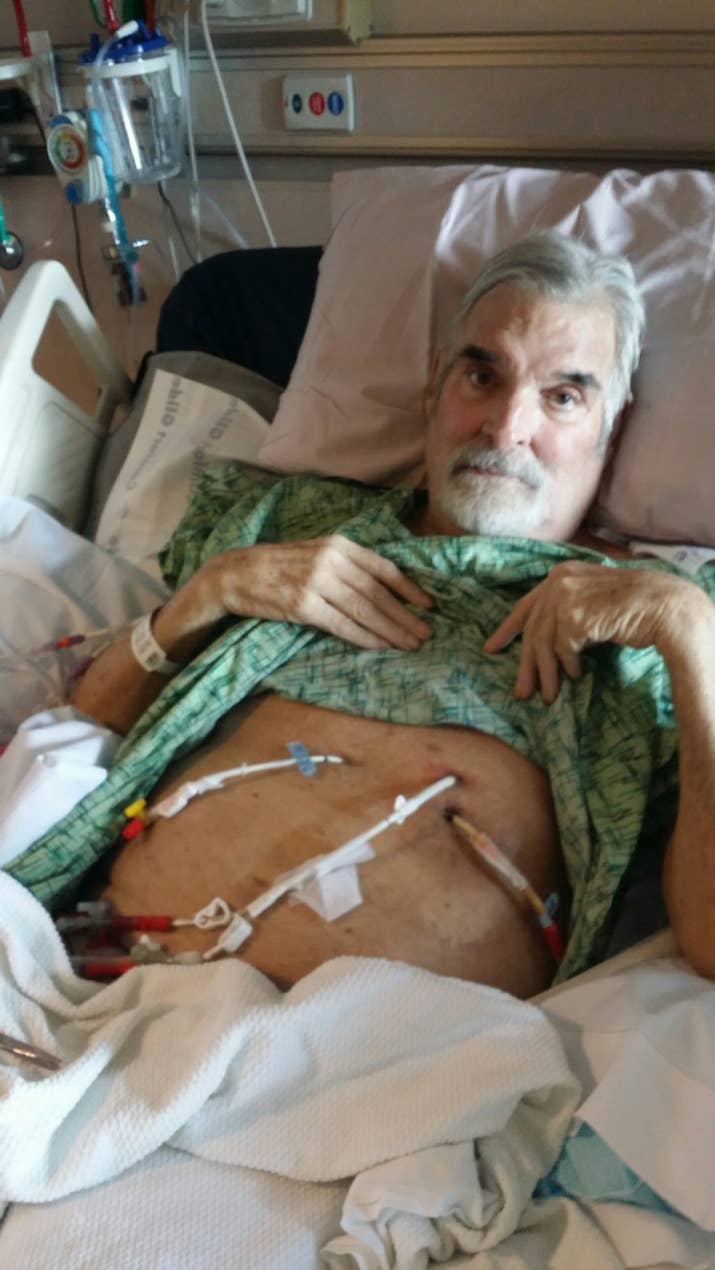
The contamination soon spread to Tom's blood and lungs. For a considerable length of time he was in a San Diego ICU bed in agonizing agony, regularly fantasizing, falling all through a state of extreme lethargy. By late February of 2016, his specialists said they were out of choices. 

Tom's significant other, Steffanie Strathdee, is the chief of UC San Diego's Global Health Institute, and one of the world's specialists on how HIV spreads over the world. She profoundly saw how superbugs, left unchecked, would murder a huge number of individuals — including, all of a sudden, her significant other. 

Sitting in the healing center room, she swung to Tom. "Nectar, the anti-infection agents aren't working," she said. "I have to know from you on the off chance that you need to continue battling, on the grounds that I would prefer not to keep you alive only for me. Crush my hand on the off chance that you need me to push ahead." He pressed.
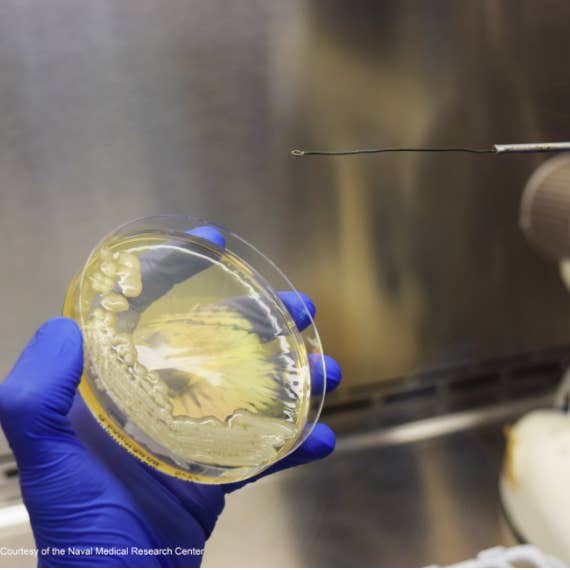
Throughout the following seven months, Steffanie went on a momentous medicinal journey, and one that won't not have been conceivable notwithstanding her special position in the more elite class of scholastic science. She accessed exceptionally old treatment — "phage treatment" — in which a patient gets uniquely designed infections to murder their putrefying contamination. Furthermore, she and her partners found these infections, called phages, in a shocking spot: an intensely watched Maryland lab keep running by the US Navy.
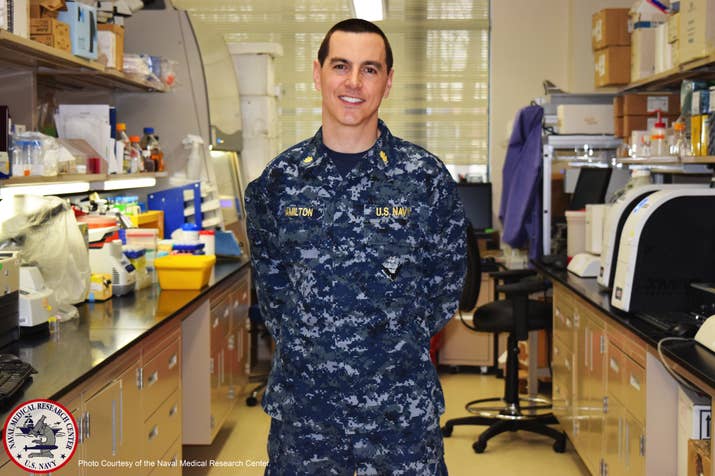
Theron Hamilton, head of genomics and bioinformatics at the Biological Defense Research Directorate of the Naval Medical Research Center

This is bizarre, not slightest in light of the fact that standard researchers have since quite a while ago rejected phage treatment as a periphery thought pushed by whimsies who appreciate angling in sewage (where numerous phages live). Be that as it may, in the course of recent years, as an ever increasing number of microscopic organisms have developed approaches to dodge our anti-microbial weapons store, Navy researchers have swung to phages as a last line of resistance. A regular cooler in the Maryland lab holds what's one of the world's biggest phage libraries: more than 300 infections, gathered on ship-based research centers everywhere throughout the world. None of the phages had ever been tried in a tainted individual — until Tom. 

"This has never been done anyplace in the nation until this case," said Lieutenant Commander Theron Hamilton, head of genomics and bioinformatics at the Biological Defense Research Directorate of the Naval Medical Research Center. A week ago, his group displayed Tom's case at a phage gathering at the Institute Pasteur in Paris. 

In any case, while the researchers in Paris praised the 100-year commemoration of the disclosure of phages, these organic weapons are almost difficult to get to patients in the US. Utilizing nature's own infections to treat contaminations doesn't jive with the FDA's procedure for supporting new pharmaceuticals, nor Big Pharma's rationale to offer one-estimate fits-all pills for the masses. 

"Everyone — the FDA and the medicinal group by and large — has been ease back to go out on a limb that would be required to truly draw in completely with a phage therapeutics program," Hamilton said. "I would prefer not to sound excessively dismissive, yet I don't think anyone is anyplace near where the Navy is on this."
Phages attacking a bacterium

The day after her diminishing spouse pressed her hand, Steffanie conversed with an associate whose companion had gotten a comparative anti-toxin safe disease. In a urgent scan for a treatment, this companion of a companion had flown the distance toward the Eastern European nation of Georgia to attempt phage treatment. It had worked. 

Steffanie, who has a degree in microbiology, recognized what phages were yet had never caught wind of utilizing them on individuals. In the wake of delving through the papers in English on the treatment, she discovered only a modest bunch of case reports of patients attempting phages in US healing facilities, or who had figured out how to request them from Georgia. In any case, these were remarkable cases. 

Phages are the most different and various living things on earth — a great many them coat our skin, live inside our guts, and move through our fixtures. They're totally innocuous to us, yet dangerous to microbes. What's more, not at all like anti-infection agents — which wipe out wide swaths of microscopic organisms, even species that are gainful to us — phages have particular targets. A phage infuses its DNA into its prey, which then reproduces quickly before breaking and executing the cell, discharging considerably more infections to rehash the assault.

Tom Patterson

"It's the main prescription that develops," Ryland Young, leader of the Center for Phage Technology at Texas A&M University, revealed to BuzzFeed News. 

Phage treatment bloomed in Eastern Europe after World War II, to a great extent since scientists there were obstructed from building up the mass-delivered anti-infection agents clearing the West. 

"On the off chance that you went to major logical meeting in the US in the 1950s and discussed phage treatment, you'd be giggled out of the room," Young said. "The Eastern Europeans kept it alive in some routes, in light of the fact that in the West we were really fleeing from it." 

Right up 'til the present time, centers in Georgia offer phage treatment "mixed drinks" close by anti-toxins as a standard treatment for battling against bacterial diseases. 

Then, the 130 distinct anti-infection agents recommended each day in the US are gradually however unquestionably losing the war against microorganisms. Six superbugs specifically, known as the "ESKAPE" pathogens, have developed as the greatest dangers to human wellbeing, tainting no less than 2 million Americans consistently, and murdering no less than 23,000. 

Tom's microscopic organisms, Acinetobacter baumannii, is the "An" in "ESKAPE." But Steffanie was resolved not to give her better half a chance to wind up noticeably one of those insights.


Her initially call was to the leader of the irresistible malady unit at UC San Diego, Chip Schooley. "I stated, 'Hello Chip, I believe we're coming up short on alternatives. Shouldn't something be said about phage treatment? I know it sounds a little charm, however I think it might be our lone shot,'" she reviewed. 

"It was a radical approach," said Schooley, a virologist whose claim look into includes discovering approaches to execute HIV, hepatitis C, and herpes. "I attempt to dispose of infections, not utilize them to attempt to treat patients." 

In any case, he was immediately persuaded that phages were likely Tom's just alternative. He consented to call the FDA and see whether the organization would enable him to give Tom phages as a "sympathetic utilize," which means a test treatment that does not need to keep typical medication controls. In any case, to start with, Steffanie expected to discover somebody who had phages that coordinated Tom's particular contamination.
She discovered Ry Young at Texas A&M, one of only a handful couple of researcher in the US who's attempting to see how phages function. Steffanie sent him a long email about Tom's story, with a photograph of Tom in his doctor's facility bed. Youthful gets these sorts of frantic messages a great deal, and normally gives a conciliatory canned reaction. Yet, when he got notification from Steffanie, he concluded that she was proficient and associated enough that phage treatment could really spare her better half. They wound up chatting on the telephone for two hours, and Young consented to offer assistance. 

Steffanie sent Young an example of Tom's superbug, and Young promptly started testing it against the little library of phages his Texas group had amassed. None worked. 

"So I did two things: I messaged and called everyone that I knew on the planet that had look into projects with baumannii phages," Young said. He called analysts in India, Australia, and Europe, and at a little organization in San Diego. Inside two or three weeks, he got about 45 phages from around the globe. 

At that point he went on what he calls a "decent antiquated phage chase" — gathering tests from sewage plants in Texas and separating almost 100 different phages that may work for Tom. 

The FDA, in the interim, returned to Schooley. They let him know they'd given Tom a chance to experience phage treatment, the length of the last item was completely refined. They additionally gave him another contact they thought may be useful: the nation's biggest phage accumulation, at the Navy lab.


For quite a long time, the Navy had just tried its phages in mice. At the point when Hamilton went ahead as the executive in 2015, he was urged to close down the phage explore arm, which he was told was a "money related opening." Instead, he chose to at last test their phages in individuals. 

Tom was the ideal initially case. "Somebody's life was remaining in a critical state here," Hamilton said. "I saw no reason not to attempt." 

On March 15 of a year ago, Schooley got a FedEx bundle containing styrofoam coolers of sanitized phage mixed drinks from Young's lab, set apart with a "biohazard" sticker. That same day, the FDA formally approved the test treatment. There was no opportunity to lose: Tom's kidneys were coming up short and Steffanie had recently marked his dialysis papers. 

"The day the main clump of phages went to Tom's bedside, the lead drug specialist brought them as though he was the ringbearer at the wedding function," Steffanie said. "It was strange taking a gander at this — an illustrious parade or something to that affect." 

Schooley pumped those phages through tubes in Tom's stomach, gone for the first site of his contamination. After two days, the Navy's more powerful phages arrived. For these, the specialists utilized a more outrageous approach, infusing the infections straight into Tom's circulation system — a technique that, as far as anyone is concerned, had never been done in the US. 

The following day, Tom went into septic stun. "Everyone thought we'd murdered him," Steffanie stated, and they immediately killed the phage implantations. Be that as it may, as it turned out, the stun was brought about by an alternate sort of microscopic organisms. In this way, after two days, they continued the phage treatment. "It was only an exciting ride," she said. 

Not long from that point onward, Tom opened his eyes without precedent for weeks, and perceived his little girl remaining by the healing facility bed

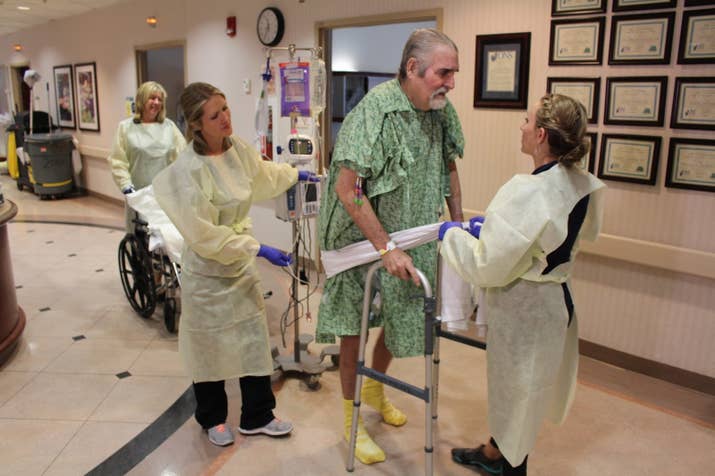
After a month, Tom went outside interestingly, in a wheelchair. He had quit utilizing a ventilator, started talking, and played gin rummy with his little girl. 

In any case, the fight wasn't over. Around a similar time, the Iraqibacter ended up noticeably impervious to the phages, and Tom's wellbeing started to pointedly decay, once more. 

Schooley sent a specimen of the changed microorganisms back to the Navy. Hamilton's group screened their phage library once more, and sent back another, carefully fit mixed drink to assault the new period of Tom's disease. 

Everything occurred inside a couple days, which Hamilton sees as one of phage treatment's many points of interest over customary pharmaceuticals. "There's positively no examination," Hamilton said. "It could be years to build up another medication." 

In August, nine months after Tom left Egypt, he at long last left the healing facility and went home. 

"In my psyche, I was the greatest guinea pig on earth," Tom revealed to BuzzFeed News. He's as yet 100 pounds lighter than when he was first hospitalized, however is at last returning to ordinary life and to his brain science explore at UCSD. "The organization that was beat, the quantity of researchers that went to my guide — they made my survival conceivable."


Tom's case is impelling activity in the Navy's fiscally stale program for phage treatment. Hamilton's group has subsidizing to hereditarily arrangement each of the 300 phages in their library, the initial move towards getting the FDA to endorse a formal clinical trial. Once the specialists screen the phages to ensure they don't contain qualities for poisons or anti-microbial resistance, they will begin huge clinical trials in individuals. 

Hamilton trusts the trials, which they're wanting to do this mid year as a team with a privately owned business called Adaptive Phage Therapeutics, will deliver enough information to take the phages to advertise. Despite the fact that the medicines will at first be for the US military, the organization could market them. 

Hamilton trusts that the FDA will enable it to sidestep one of the fundamental obstacles now confronting phage treatment in the US: Each hand crafted phage mixed drink would should be affirmed as its own particular medication, a stringent procedure that would make phage treatment everything except incomprehensible, Hamilton said. On the off chance that the FDA rather endorsed the entire library, then specialists could make customized mixed drinks for every patient without requiring endorsement each time.
"On the off chance that each phage is viewed as another medication, there will never be a phage treatment industry," Young said. 

In any case, Hamilton recognizes, rolling out this improvement would be an "outlook change" for the FDA, and it still can't seem to freely flag that it's something it would significantly consider. The organization declined to remark for this story. 

Cash, as well, hinders conveying phage treatment to the masses. Since phages, similar to anti-infection agents, are taken for brief timeframes and will never be blockbusters like Viagra or Lipitor, couple of pharmaceutical organizations would make the speculation to put up them for sale to the public. Furthermore, since phages can be found in nature, protecting would likewise be troublesome. "On the off chance that an organization puts cash in phages, there's nothing to shield some individual from confining another phage that is near it and doing likewise," Young said. "That is an issue." 

The boundaries imply that phage treatment is in all likelihood not going to be the answer for the developing anti-infection agents emergency. In any case, with no new anti-infection agents in the pipeline, this unordinary treatment is one of the main things that may really offer assistance. "I question that will move in the opposite direction of anti-microbials whenever sooner rather than later," David Weiss, chief of the Antibiotic Resistance Center at Emory University School of Medicine, revealed to BuzzFeed News. Be that as it may, he included, "conventional anti-microbial treatment and phages may in principle be utilized together." 

Steffanie will be a coauthor, alongside Hamilton, Schooley, and Young, on an anticipated logical paper about Tom's phage treatment experience, and she and Tom are taking a shot at a book. 

"Phage treatment as a field sort of slammed into our lives in this supernaturally strange way," she said. "Each time I take a gander at him now I simply imagine that consistently is a blessing." ●
Read More

Sunday, May 7, 2017

6 Ways Emmanuel Macron Rewrote The Script Of European Politics

5:43 PM 0


France's new president – its youngest ever – got where he is by breaking with the conventions which have recently defined politics in Europe.
An autonomous moderate structures another gathering, keeps running on a star EU stage, and after a year goes ahead to win the French administration. Only a couple of months prior it would have seemed like the start of a joke. 

However, Emmanuel Macron saw superior to anything most how governmental issues functions in 2017. From the European Union, to movement and battling fake news – where many would have attempted to change the subject – he turned tradition on its head. 

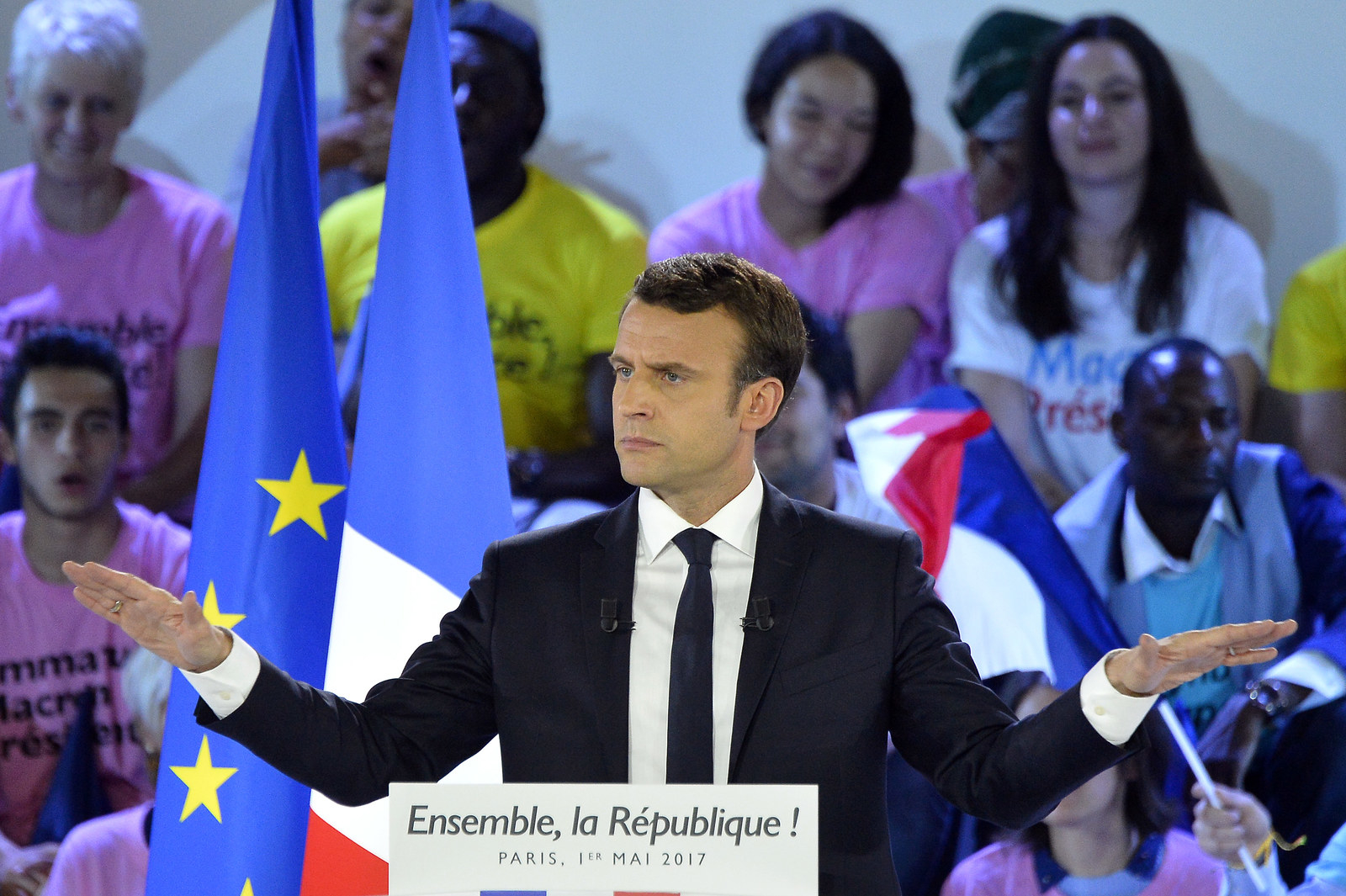
At 39, he is France's most youthful ever president. His triumph, as most race wins, had components of good fortune: an embarrassment over fake occupations hampered the odds of preservationist applicant François Fillon. In a nation where keep running off votes are regularly about dismissing one of the two competitors, Marine Le Pen was the enemy most inclined to dismissal. 


Still, the National Front won a bigger number of votes than it ever has. Europe's populist far-right wave hasn't all of a sudden vanished, however nor is its proceeded with ascend as unavoidable as a portion of the media scope since the Brexit vote, and Trump's race in America, frequently appears to suggest. The condition of France's economy has been instrumental to the Front's ascent, and few can anticipate what the economy will look like in 2022.
The emergency on the left – communist François Hollande will leave the administration as France's most disagreeable president – has additionally made a difference. 

A great deal will be currently composed about the operations of a triumphant crusade that from numerous points of view was enlivened by the playbook of Barack Obama. 

Yet, most importantly, Macron's remarkable way to triumph is the tale of a competitor that was intense – and to break, on his approach to control, large portions of the ordinary decides that have characterized the European governmental issues generally. 

1. He propelled another gathering without any preparation 


At the point when Macron established En Marche! (On the Move!) 13 months back, many individuals ridiculed him. A pastor tweeted a connection to a melody titled "Je marche seul" ("I walk alone") joined by the hashtag #Amiens, a reference to the new-conceived development, and Macron's main residence, where En Marche! was being propelled before a few hundred individuals.
Others thought the thought would come up short. "He's aggressive. He may do well, however anti-extremists never move toward becoming president in France," a senior French government official revealed to BuzzFeed News a year ago when gotten some information about Macron's odds. 

In the interim, as Macron rose in the surveys, a great part of the analysis stayed focussed on Le Pen: the far-right versus the foundation is the essential focal point through which the story of Europe is being sifted. 

In any case, the far-right is just piece of the story. A move has been occurring in numerous European nations. Legislative issues is no longer a fight between right versus left, yet a decision between open or shut economies and social orders. For various standard gatherings, particularly among social democrats and the coalition of voters they have truly depended on, such contrasts have turned out to be progressively severe and conceivably hopeless. 

For Macron, legislative issues is about this decision. You can't win the approach contentions, in the event that you don't likewise win the open deliberation about qualities and personality. 

What's more, no hopeful better exemplifies the thoughts of protectionism, nativism, hostile to globalization, and patriotism than Le Pen. She and Macron are oppositely inverse. They so plainly epitomize the colossal division of our age. 

Le Pen had been surveying around similar levels since mid-2013, everything except sure to make an overflow vote. The question was dependably who might confront her in the second round. Be that as it may, France in 2017 was no longer the France of 2002 when the close whole of the nation joined around Jacques Chirac against Jean-Marie Le Pen. 


En Marche! furnished Macron with a stage that was neither left nor right. Free from the structures and things that accompanied the built up partitions, it gave him the capacity to keep running as a pariah against detested standard gatherings that have dependably represented, and as a voice of expectation against the National Front. He gave France a positive thought of itself to restrict the slaughter painted by Le Pen.

2. He was unapologetically pro-EU

Macron was the main contender to keep running on a professional EU stage, an irregular position contrasted with the numerous government officials crosswise over Europe usual to utilizing "Brussels" as a substitute for residential issues, or as an arousing call to join against amid decisions. Indeed, even those that are not eurosceptics, attempt to keep the EU off the motivation. 

"In case you're a bashful European, you're now a vanquished European," Macron told columnists in the wake of meeting German chancellor Angela Merkel in Berlin a month ago. 

At the point when a French supporter expelled an EU signal fro
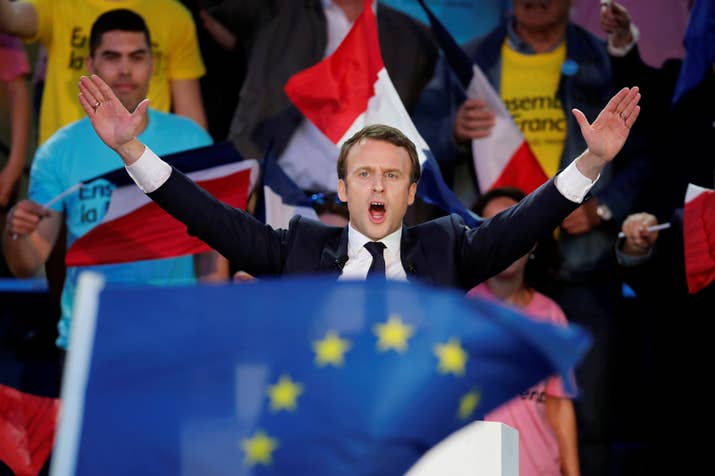
m its studio after Le Pen demanded that lone the French banner be noticeable amid a meeting, Macron made that big appearance at his next crusade occasion with an EU hail in his grasp. It is "a respect" to fly this banner, he told the rally in Nantes. "We are one of these stars... prior to this banner, our own was a mainland of war, always remember that," he said.

By crusading on a genius EU stage, France's new president could make the EU a top race issue, an approach to call attention to that the counter euro and against organized commerce stages of populist gatherings would in actuality end with the nation leaving the EU. (The greater part of voters in France are supportive of the euro and EU enrollment). 

Macron was likewise ready to adjust his safeguard of the Union close by arrangements to change it. 

"I am not in any manner guileless — I think you can win a decision today by guarding Europe," Macron included Berlin.

3. He gave Le Pen the referendum on globalisation she craved – and won it

Addressing her supporters after the first round, Le Pen stated: "What is in question in this decision is a choice for or against rebellious globalization". 

Far-right hopefuls and populists get a kick out of the chance to casing races as votes against "globalists" and "elites". They rally against "open fringes", and for "reclaiming control" from "foundation" strengths. They fill these frequently unique terms with enthusiastic importance making it simple for anybody to venture whatever they need onto them. This edges the terms of the open deliberation. 

Most standard government officials tend to timid far from these issues trusting that hard monetary contentions will suffice. Yet, in votes driven more by feeling and contentions over character than by truth checkers, financial figures and debunkers, they can wind up on the losing side.
In spite of the fact that there is no evident single formula for testing conservative populism, Macron gave Le Pen the contention she pined for so much – and won it. 

Throughout an over two hour discuss on Wednesday, he utilized coarseness and certainties to uncover her monetary arrangements. He called her arrangements to utilize both the euro and a national cash "doltish". He tranquilly picked openings in her contentions, and over and again said she was badly educated and a liar. 

At the point when Le Pen attempted to paint him as the competitor of the "foundation" and the "framework", he hit back saying she was a "parasite" on the very framework she was reprimanding. He marked Le Pen as "the high priestess of dread", and said her movement strategies were brimming with loathe. 

He depicted her as "unworthy" of being president. "Madame Le Pen, France merits superior to you," Macron said. 

After the verbal confrontation, a survey found that Macron was viewed as all the more persuading by a larger part of voters that had watched the civil argument. His lead in the last surveys of the battle enlarged to more than 20 focuses.

4. He was able to distinguish between Le Pen and her voters

One of the reasons mainstream politicians stay away from debating issues that are charged with emotions is for fear of being chastised as patronising by the supporters of populist candidates, or ignorant of their concerns.

Former British prime minister David Cameron got into trouble for once calling UKIP members "fruitcakes, loonies and closet racists, mostly". Similarly, Hillary Clinton quickly regretted describing some of Donald Trump’s supporters as a “basket of deplorables”.
Macron was uncompromising in his criticism of Le Pen, but was always careful to distinguish between the National Front and its supporters.
Amid Wednesday's level headed discussion he blamed Le Pen for rambling against things, however proposing little to really help the general population whose wretchedness she was nourishing off. 
"I consider voters as grown-ups", he said. 
He made the verbal confrontation about highlighting the differentiation in world perspectives, as well as the diverse proposition each was putting forth to address voters' particular concerns. 
Still, all through the battle he not even once made suggestions to Le Pen herself, or successfully standardize her gathering or its approaches – undoubtedly he depicted both as inconsistent with the estimations of the French Republic.

5. He engaged directly with her voters (and their concerns)

Race battles in Europe have turned out to be scripted and dreary illicit relationships, the domain of soundbites and stage oversaw occasions – and quite a bit of Macron's, obviously, was as well. 

Be that as it may, only a couple days after the first round vote, Le Pen sprung an unexpected visit to an industrial facility undermined by conclusion in northern France where Macron was crusading. 

As she brought selfies with gathering supporters, Macron was met with sneers and calls of "Marine présidente" by a picket line of furious laborers. 

A significant part of the media scope, in English in any event, portrayed the episode as disorderly, as Le Pen upstaging Macron. 

Be that as it may, Macron then spent about a hour debating with the specialists, in what was on occasion a blazing trade livestreamed on Facebook, and saw more than 650,000 times. It was a gutsy move, however it paid off. He cleared out shaking hands with the laborers. 

En Marche! included an article and video of the visit on the landing page of its site until the very end of the crusade.

6. He directly countered fake news – and made the issue part of the campaign

Fake news, disinformation, and asserted battles to meddle in races have turned out to be regular staple in late votes. France was no exemption. Only 36 hours before the surveys opened for the second round, the Macron battle was hit by a hacking assault, and crusade messages were released on the web. The crusade said fake records had been added to the online dump. 

In decisions in different nations, battles were almost constantly one stage behind when it came to fake news, hacking and disinformation. Over and over again they responded when it was at that point past the point of no return. For Macron's situation, the default setting was they would endure an assault. As per a report in The Daily Beast, the battle even planted false data on phishing pages to jumble programmers. 

Macron, and his battle, took the issue of countering fake news, and the effect it has on the law based civil argument, head on: they anticipated it, and they even made it a player in the crusade. They checked nearly and mediated instantly when false claims seemed as though they could become a web sensation, and they got a handle on the worldwide measurement of the issue and stapled the issue to the far-right.
Right off the bat, the crusade let it be known they were being focused by Russia. They later restricted the Kremlin's promulgation outlets, RT and Sputnik, from crusade occasions alluding to their "precise craving to issue fake news and false data". 

Furthermore, the battle deliberately utilized Macron, and his web-based social networking channels and media appearances, to counter fake news stories and bits of gossip. The applicant utilized meetings to expose a few fear inspired notions.
At the point when Le Pen inquired as to whether he held a seaward record in the Bahamas, in reference to a fake news story that was coursing on the web, he debilitated to sue her for defamation. The following day his battle recorded a dissension with French specialists provoking an examination, and put out an announcement reprimanding the National Front for spreading fake news, and denouncing "the online systems of Trump and Putin" of propelling a "crusade of computerized disinformation". 

Le Pen was compelled to concede she had no proof to back the cases.
Macron and En Marche's next test will be parliamentary elections next month. For France's new president comes challenge of governing a deeply divided country, and rebooting its economy. For now, his election will go down in the annals.
Read More

Friday, May 5, 2017

The Trump Boom Is Happening On Paper, But Not In The Real World

3:00 PM 0
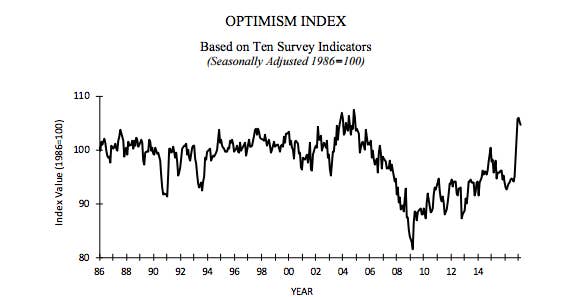
   Consumers and CEOs are expressing confidence at historically high levels. But       they're not celebrating by buying a new car just yet.

An example is ending up plainly clear in 2017: individuals' emotions about the Trump-time economy are far outpacing how the economy is truly performing. 

The economy is looking incredible, everybody says: in money markets, financial specialists are pushing real files to record-breaking highs, and in long-running reviews on purchaser assessment and monetary positive thinking, there's an accord that things are great, and set to show signs of improvement. 

Conclusion among entrepreneurs, as measured in an overview done by the National Federation of Independent Business, has surged since the decision and has been at "generally abnormal states for five months." In another progressing study by the Business Roundtable, business pioneers revealed their biggest hop in positive thinking since 2009, particularly for projections of offers, procuring, and close term venture arranges. 

The Conference Board said its measure of CEO Confidence shot up in the principal quarter of this current year, and the University of Michigan's shopper feeling review remained at its high post race level in April. These are great circumstances, organizations and customers say.
"Feeling has enhanced a bit, specifically for substantial multinational organizations, that is reflected in higher stock costs, and that hues view of the economy," Mark Zandi, the central financial expert for Moody's Analytics, disclosed to BuzzFeed News. 

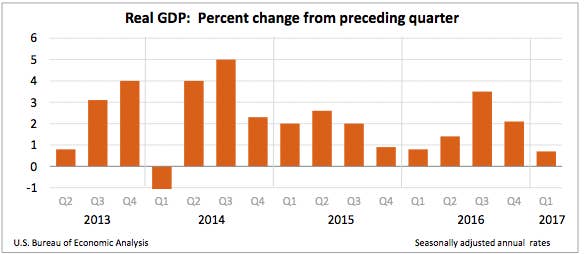
In any case, little of this seems, by all accounts, to be appearing as genuine monetary movement presently. The U.S. economy just grew .7% at an annualized rate in the initial three months of the year, as indicated by a preparatory gauge from the Commerce Department. The economy has developed at a little more than 2% for as long as three years and many expected comparable numbers this year.
Employing is additionally yet to mirror another condition of seething business good faith. The month to month employments report discharged on Friday morning demonstrated the economy included 211,000 new occupations in April, flawlessly in accordance with month to month reports from the most recent couple of years. The unemployment rate has ticked down to 4.4%, its most minimal since May, 2007.
And keeping in mind that individuals say they are expecting great circumstances ahead, they're moving in an opposite direction from purchasing new autos at a rate last observed amid the budgetary emergency. Real auto producers detailed enormous falls in US deals for April: Ford's fell 7% from a year prior, GM's dropped 6%, Toyota's were down 4%, and Nissan's were off by 1.5%. It was the fourth back to back month of falling auto deals, the longest streak since 2009. 

A few examiners say those abating deals aren't really indications of a declining economy. Rather, many banks and back organizations have taken care of their loaning approaches for auto purchasers following quite a while of generally free gauges and blasting auto deals. The surge in auto deals in the previous two years has additionally expanded the quality and supply of utilized autos, said Zandi. 

Different signs indicate a harder domain for shoppers who acquire cash. A few loan specialists have revealed huge increments in the measure of charge card obligation they are discounting — basically cash they are abandoning gathering. Capital One has expanded its gauge for obligation benefits this year, and set aside cash for future misfortunes. 

Since Capital One has concentrated on loaning to sub-prime borrowers, it is "more inclined to vacillations in credit quality," CreditSights investigators said. At Synchrony Financial, which issues many store Mastercards, obligation benefits expanded in the initial three months of 2017. CreditSights ascribed the higher charge-offs over the business to organizations following weaker borrowers before, and the maturing of those advances. 

"The economy doesn't move in a straight line," Zandi said. "That doesn't mean something essential is turning sour, it's going great. The economy was on essentially solid ground a year prior, it's on solid ground now, it would take a ton to wreck it." 

In the case of anything, the present, Trump-propelled highs in monetary positive thinking could themselves represent a hazard, Zandi said. "There is a potential that slant drives valuations to such levels that business sectors are powerless against something that may turn out badly."
Read More